
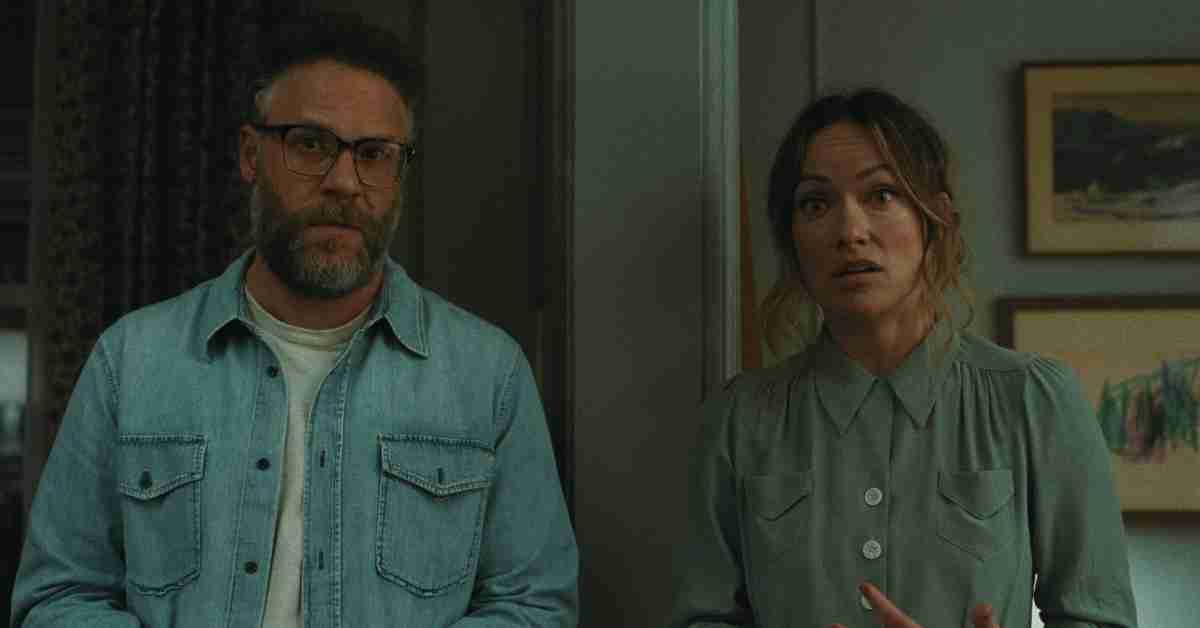
Pausing the early-summer flow of big-studio animations, we stop off for a comedy designed as a one-set stage play, and find ourselves clamped by a demanding, highly-strung, voyeuristic drama. We arrive in time to gawk at a middle-class, middle-aged, middle-income, white American couple—whose only distinction is a steady habit of talking over each other—welcome their sexy, free-spirited neighbours for dinner. Joe huffs and puffs home after work and is thinking about himself. “Can you please remind me why you got me this bike?” he says. Angela frames deli-style ham and cheese on plates. She frets about her twelve-year-old daughter’s sleepover. “There are no men or weapons in [that] house,” she says. They argue. “I told you yesterday,” Angela says. “We’ve been talking about them coming for, like, six months.” “Why didn’t you ask me about this?” Joe says over her. “Telling me and asking me are very different things.” “Can you please just clear up your office?” Angela says. “It’s such an eyesore.”
The neighbours have accepted “The Invite” (Annapurna Pictures), showing now at the Montrose Playhouse. A second “invite” will come later on.
Joe, played by Seth Rogen, is selfish and paranoid. He repeats himself even though we understood the first time. As he shucks off his shirt, displaying his flab, he complains about the noise the neighbours make in bed. He plans to get them to stop disturbing him. But Angela is a scholar of the social niceties of the English. “Don’t say anything,” she says. “Just not tonight. Please.” “These people are disrespecting me,” Joe says. “They’re not thinking of us,” Angela says. “Maybe that’s the problem,” Joe says.
Angela, played by Olivia Wilde, is anxious and controlling. “Please don’t eat the cheese, Joe,” she says. “I worked so hard on that.” It took her hours to scour the oven. Joe failed to buy wine. But Pina, played by Penélope Cruz, refuses to eat. She follows a diet of “no gluten, no dairy, no meat, no sugar.” Angela’s grand design is in ruins and her low self-esteem re-emerges. “Fail, fail, failed on the food,” she says.
Because they don’t follow dinner-party etiquette, Pina and Hawk, played by Edward Norton, are disruptors. They let each other speak. They are as direct as their hosts are slippery. “Are you sure we’re not interrupting something? It sounded like you were arguing. We wondered if we did something wrong.” Angela cuts off Joe‘s big speech—multiple times. But her bigger problem is that she is blindsided by Pina’s complements. “How’s your daughter?” Pina asks. “She’s so cool. I love her style.” Angela misspeaks about “being alone” when their daughter leaves home. (“What about me?” Joe says.) She panics because the corkscrew hasn’t been returned to its correct storage space. She apologises over and over. “Sorry. We don’t have people over very often.”
Hawk is charming; he likes being with people; he has a high opinion of fun. He hands a homemade flan to Angela. “You’ll be at [our] door [having tried the flan once] like a junkie under a bridge saying, I need a score. Heroin.” His ease strains Joe—“Is it pronounced ‘flan’ or ‘flarne?’” Joe snuffles the escalating threat to his standing as the alpha and pokes Hawk’s working-class job as a firefighter.
Danger flashes when Angela is revealed as dishonest. “I don’t understand how you put this together so quickly,” Pina says. The dinner was only arranged that morning, not the previous day. Joe has been telling the truth, not Angela. Angela’s reliability as a narrator is shattered. In one of many excellent split-scenes, she suffers a panic attack at the moment Hawk opens her bathroom cabinet and peers at several shelves of pills.
Hawk oozes over Angela’s charity-shop rug. “You found a Van Gogh in a garage sale,” he says. “Wow you have a gift. I just wanna take off my clothes and lie naked on it.” She shows him round. “This is an immaculately presented vintage bathroom.” “Wow, do you work as a photographer?” “I think you’re really talented.” Can he see the bedroom? “It’s not part of the tour,” she says. “It’s a pretty important room,” he says. The audience knows what Angela doesn’t, quite: that she is being conveyed across the threshold of the great unknown. She gossips about her husband’s inheritance. “We could never in a million years afford this [flat],” she says. And later she will say that she is “marinading in this horrible environment every day.”
The decision to use cannabis to catalyse the Joe/Pina flirtation is odd. It doesn’t add anything. They don’t need the help. For the last few weeks Joe has been ogling Pina’s breasts in the lift. “Do you feel worthy of desiring them?” Pina asks. She can diagnose Joe’s class snobbery just as well as the audience. Angela’s ham is from a bargain supermarket; Pina says it’s not “real jamon.”
A short while later Joe gets back on track. “Look, anyway,” he says, “the noise has been a thing.” Angela bustles and the camera unsteadies. “We have not heard anything,” she says; then, as if she has changed her mind, she flips the direction of the complaint by apologising for their own noise. But Hawk is too cool to miss the sleight of hand. “Joe has something on his mind,” Hawk says. “No, we actually haven’t heard anything,” Joe says. “Joe, Joe, Joe,” Hawk says. “Joe, don’t lie. You’ve been telling the truth all night. I love it when you tell the truth.”
No good will come of the second invite. Angela has been applying samples of paint to the bedroom wall. Guests aren’t supposed to be in here. The job is unfinished—a metaphor for the dinner which will never reach coffee. Hawk studies the windows. “This whole single-pane stuff,” he says, “it will shatter with even a little bit of heat.” “This is a very cold apartment,” Angela says. “You never know!” Hawk replies.
Adam Poole
4th July 2026
If you are interested in viewing this screening, please book your tickets here
