
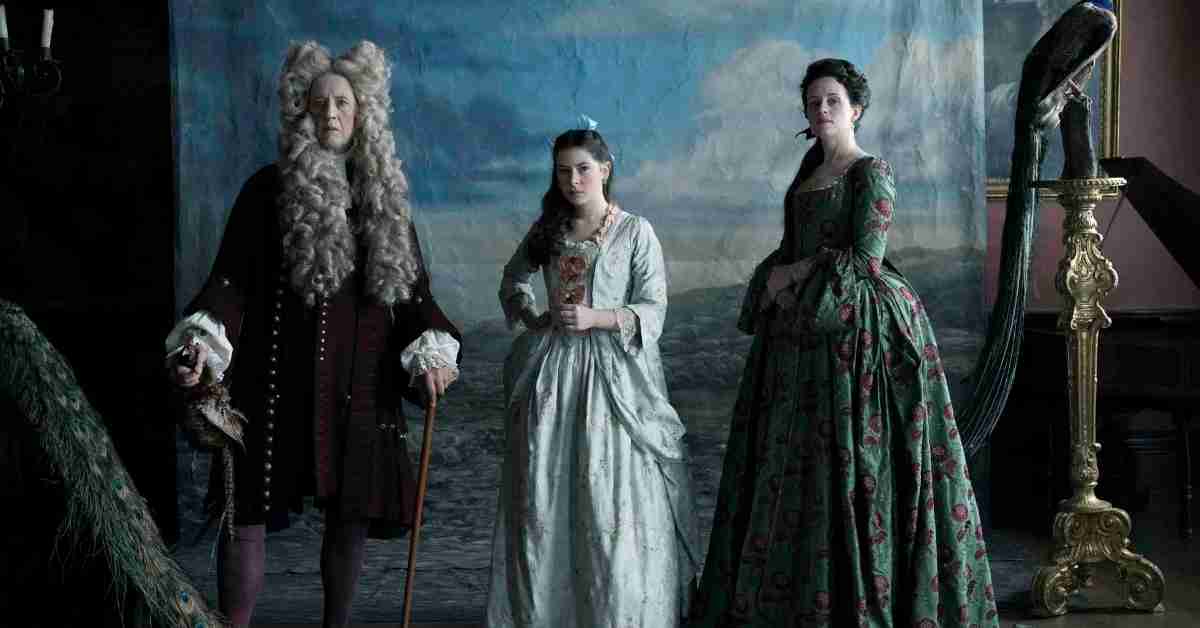
As well as aristocrats, Great Britain has provided the world with shows about aristocrats and spoofs of these shows. It’s quite the racket. At the end of “Savage House” (Paramount Pictures), showing now at the Montrose Playhouse, actor Richard E. Grant smears white face cream and powder onto his cheeks while admiring himself in the mirror, Evil Queen-style. “Not bad, old boy,” he says, “not bad at all.” Mr Grant is chuffed to be there. The character he has been playing isn’t so much an aristocrat but Kenneth Williams; and the film we have been watching isn’t so much a parody of, say, Downton Abbey but a remake of “Carry on Don’t Lose Your Head.” In the 1967 film a British aristocrat disguises himself as the “black fingernail” to sabotage Citizen Camembert (Mr Williams’s role) and his guillotine and enable fellow aristos to escape from the French Revolution.
Mr Grant’s amoral, hard-drinking character is a “ruffian and opportunist,” “nothing more than the son of a penniless peddler” who has the wit to “marry up” and “purchase his title of ‘sir’ [Chauncey].” He is “a rake on the make” who enjoys “brothels and gambling hovels” and cheats using an “altered pair of dice that he had meticulously melted.” His creditors are after him for his “reckless spending and misadventures.” He has “slowly siphoned off” parcels of his wife’s land, “over-leveraging and double-dealing.” But he is full of righteous indignation. “We’re not about to let some greedy banker steal our home,” he says. As for his marital relations, “Her ladyship hasn’t touched me in months,” he says to his footman. “You’re an acquired taste, my lord,” the footman replies.
Lady Savage, played by Claire Foy, who has a tendency to speak too quickly, sports a fake black mole as well as that aristocratic white makeup. She hunts for gossip of upper-class parties to which they have not been invited (“We both know that I contain the odious stench of an outsider,” her husband says). “Maybe the gossips are right,” she says, “we do deserve each other.” Their marriage, though, is happy. “You are a disturbed child,” she says, “but I love you.” Meanwhile she sleeps with the footman and Sir Chauncey sleeps with the chambermaid. Her daughter keeps pet mice in a dolls’ house. (The film is fond of animals; as well as mice, there are horses, pigs (and just their heads), pheasants, maggots, leaches, and flies. There is also “the pox” and gangrene.)
A horseback-riding messenger delivers a surprise self-invitation from a higher caste Duke and Duchess. “We were probably fifth or sixth on the list,” Sir Chauncey says. He wants to refuse but his wife is having none of it. “I’m sorry but I will not be humiliated,” she says, and then barks orders to their two servants and pawns her grandmother’s jewellery. Sir Chauncey disappears through one of those secret doors hidden in a floor-to-ceiling column of fake books. “Miss Nevill,” he says to the chambermaid, licking his lips. “Butter my biscuit with a little clotted cream and strawberry jam!” (Some of the sexualised language later is far more explicit and would have been better cut altogether.)
Preparations begin. Sir Chauncey pontificates about a “social ladder” while watching his footman climb a wooden ladder onto the roof. “I’d help,” Sir Chauncey says, “but I’m utterly useless with a hammer.” There are some terrific lines: “No self-respecting gentleman knows his bank balance”; “Perception is everything—especially among the ruling class”; “The curtains must always match the sheets.” Characters touch the sides of their noses before revealing a secret or bragging—“don’t tell a soul, but the Duke and Duchess of Devonshire are coming to dinner.” The incessantly idle couple—“after a long day of endless eating”—are conned into paying over the odds for fine art. They sit for a gaudy family portrait, which the painter—another great character—describes as a “piece of familial forgery.” Sir Chauncey inspects the mouths of gloomy-eyed lower-class farmers. He needs two lesser men to pose as temporary servants to impress his visitors. “Who here has all their limbs?” he asks. “Including their fingers.” After the camera closes in on their disgusting teeth we are shown a mound of crawling maggots. Her ladyship is contemptuous—why not “dress up a donkey” instead? Sir Chauncey’s flamboyant wig rolls down towards his navel. “A mountainous rodent,” his wife calls it.
Their high-class neighbours, the Bennetts, also speak in a peculiarly distorted English accent. “I’ve been accused of many things, Mr B,” Sir Chauncey says at dinner, “but seriousness is not one of them.” We eavesdrop as the Bennetts leave. “Only two servants? It’s barbaric.” A few days later they are back. Mr Bennett starts crawling—he wants something. “Is that a Caravaggio?” he asks. “It’s all the gossip…,” Mrs Bennett says. “A gentleman never boasts…,” Sir Chauncey says. “Would it be too much to enquire our standing?” Mr Bennett asks. Sir Chauncey is as confused as the audience. “Our invitation?” Ah. They will get one “should someone drop out.” Ouch. Mr Bennett plays judge at the inevitable pistols-at-dawn duel (“Carry on Don’t Lose Your Head” has one too). “If I’m going to die,” Sir Chauncey says before the occasion, “I’m going to look bloody good doing it!” “Good shot, old boy,” Mr Bennett says to the victor. “What time should we arrive for dinner?”
“Savage House” is jaunty and trivial and daft and in the tradition of nineteen-sixties British humour. It overlaps with a similar film, “Fackham Hall,” which I reviewed in December. Hopefully Mr Grant, Ms Foy, et al, will remake “Carry on Cleo” next. One of the servants describes Fanny, the mouse-loving daughter, as “that snivelling snob.” But she has the clearest idea of the direction her parents are headed. “You’re going to end up in the poorhouse if you keep this up,” she says. “Not now, Fanny,” Lady Savage replies. “I’m not in the mood!”
Adam Poole
15th June 2026
If you are interested in viewing this screening, please book your tickets here
