
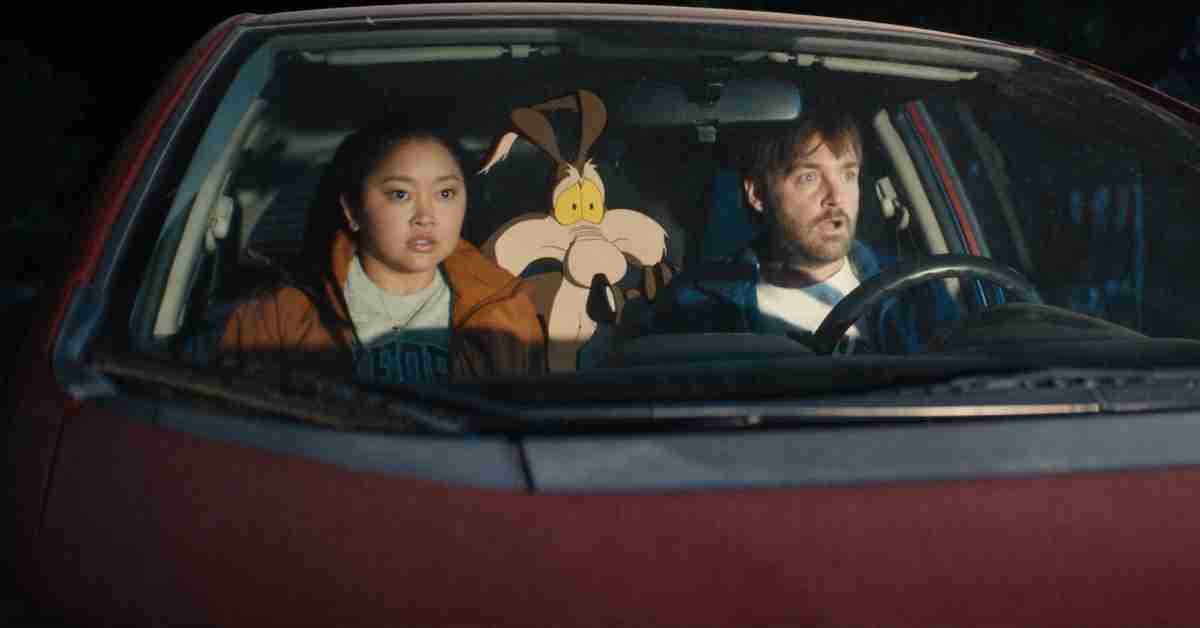
One morning, Mr Wile E. Coyote sees an advert for a firm of attorneys-at-law. He is furious that products bought to outsmart his nemesis the Road Runner don’t work. Perhaps he can sue the manufacturer? Kevin Avery’s is the kind of outfit familiar to John Grisham’s many fans in which an intern fights a cynical “just-settle” culture amongst senior partners. “I thought you were actually still a real lawyer,” the intern, played by Lana Condor, says, “as in do some work and win this case.” But it is also the sort of concern which produces those scrappy daytime-television ads in which every line is followed by an exclamation mark: “Have you ever pulled the rip-cord of your parachute and only the rip-cord comes out? It’s not your fault! There’s probably someone to blame! We’ll be your voice!” Kevin, played by Will Forte, his television-face smirking, winks at the camera. “I could probably get you two hundred and fifty bucks!” “Coyote vs. Acme” (Warner Bros.), showing now at the Montrose Playhouse, is a bellyful of gags through which the adult audience laughed and laughed at the opening matinée.
“Coyote vs. Acme” is the second “Looney Tunes” movie of 2026. I thought about the difference between cartoons and animation in my review of the first one in February. The new film flows from “Who Framed Roger Rabbit” (1988), a then-unusual type of live-action animation. “Roger Rabbit” and “Coyote vs. Acme” both mix human actors with cartoons voiced by human actors. A Wikipedia entry describing a nine-minute-long, black-and-white “Looney Tunes” movie from nineteen forty which “featured animated Warner Bros. characters interacting with live-action people” is perfect for “Coyote vs. Acme.”
Warner Bros. is now “A Fully-Owned Subsidiary of the Acme Corporation.” Acme knock out tins of paint, dehydrated boulders (just add water!), metal pellets, bird seed, rocket skates, wind turbines, helicopters, and staplers. For those unfamiliar, Wile E. Coyote’s primary purpose in life is to knock out Road Runner, a bird, and, in his failed attempts over the decades, he has tried the catapult, the bridge drop, and, of course, the magnet primed with a multi-seed mix. “It must be nice to have such a clear goal,” Kevin says. Wile E. communicates with hand-held placards; the Road Runner with “Beep! Beep!” The studio’s snappy closed-captioning helps to appreciate the movie: [groaning], [laughing hysterically], [chuckles nervously], [overlapping shouting], [stomach growling], [whooshing], [horn blaring], [anvils thudding].
Wile E. phones the number advertised on the television: “If you’ve been hit by an anvil press, press ‘one,’ … if you’ve been crushed by a falling piano, press ‘three.’” The filmmakers are enthusiastic about anvils and grand pianos and hand grenades and sticks of dynamite, whether exploded or not. After Wile E. dynamites the law office, Kevin says, “It was not entirely necessary to do that. This is a run-of-the-mill, three-hundred-dollar, rocket-skate case. Besides,” he says to his intern, who is also his niece, “we don’t do complicated cases; we do quick-and-easy.” And the firm’s “cartoon cases go to the basement.”
Checking in at the Prickly Pear Motel, Kevin says of Wile E., “He’s not a pet.” “He looks like a pet,” the proprietor says. “This is Mr Coyote. He’s my client. He’s not a pet. He may have a case against you for discrimination!” Wile E.’s bedroom soon resembles the garage workshop of a hobbyist inventor ([pounding], [drill whirring]). But Kevin stews over his client’s behaviour. “We will be polite [in court],” he says, “we will not detonate explosives.”
Acme’s defence is that “Wile E. is reckless and all his injuries are self-inflicted.” Kevin needs a whistleblower. “Eh, What’s Up Doc?” Bugs Bunny is roving about at Albuquerque’s annual carrot festival, one of his favourite hangouts. “Your trial,” he says, “I think I might be able to help you.” Clues can be found at 666, Scary Road Drive. Acme can “make people disappear,” Bugs says, “don’t forget that.” “I won’t,” Kevin says.
The untold boatloads of visual gags would fill a month’s worth of movies. Wile E. reads the book “How to Wait Around Dramatically” with his heels on Kevin’s desk. He rips up a contract then sets it on fire. He get caught in a ceiling fan and assumes its shape, as if strapped to a horizontal Catherine wheel. He photocopies hundreds of documents, his swivel chair rocking back and forward in rhythm with the pushing of the “copy” button. He pulls weapons and musical instruments from one hiding place or another under his fir at a courthouse security scanner. Even better are the facial distortions: Wile E.‘s eyes narrow in suspicion, or their lower third fill with tears, or their retinal blood vessels strain through a telescope.
The Road Runner has his own musical theme which incorporates “beep-beep” as a pulse. It’s joyous. But the biggest credit goes to Eric Bauza who voices Bugs Bunny, Daffy Duck, Porky Pig, Elmer Fudd, and Foghorn Leghorn. “Cartoons are resilient,” Mr Leghorn says in court, “they push through gravity and science.” “My clients go boom,” Kevin says, “and ten seconds later they are fine. No one cares!”
One of their sources directs Kevin and his niece-intern to St Looney’s, a mental hospital. “Well,” Kevin says, “there’s a duck, and he’s sitting.” “You’re a little late,” Daffy Duck says, “and you’re still wearing that hideous suit.” Daffy jumps into a pond. “Come on in,” he says, “the water’s freezing!” The riotous scene that follows is the finest set-piece of the movie. Daffy knows the secrets of “Project Sissy Phoose,” and the old-scientist-turned-whistleblower. “He went to work one day with a little bird,” the scientist’s wife says, picking up the story, “and I never saw him again.” She is quiet for a while. “They said he ran off with his secretary,” she says, “but I don’t think so. The secretary was a penguin.” Tweety, the little bird, has difficulty rolling his ‘r’s. “That Woad Wunner,” he says, “is vewy vewy fast, sir. Retweet! Retweet!”
Adam Poole
22nd August 2026
If you are interested in viewing this screening, please book your tickets here
