
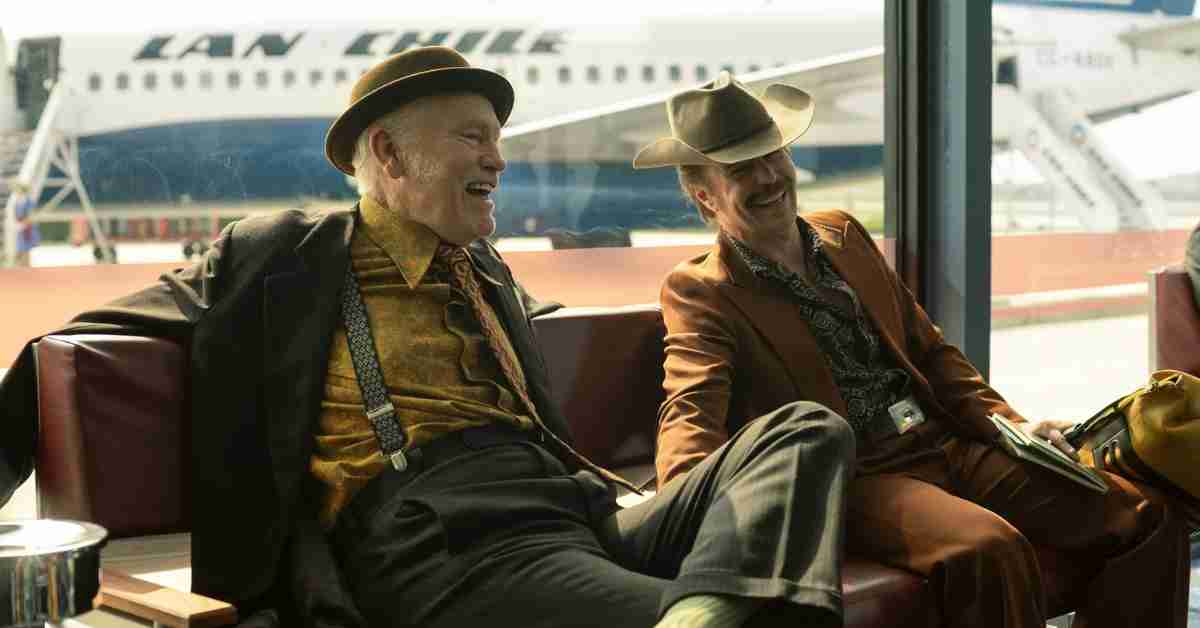
A free-speaking American assassin named Chris Carlisle is a danger to himself, his boss, and the citizens of the country to which he has been assigned. “I’m a big shot within the CIA,” he likes to say. But “you get old; you start to forget shit; regret shit.” He may—or may not—have asked his buddy, Lee, to kill him; have secrets about the assassination of President John F. Kennedy (1963); and have insider knowledge of the upcoming Chilean coup (1973). In a novel, he would be an unreliable narrator—or unreliable witness. His terminal cancer and morphine addiction have caused lost inhibitions and fading memory.
“Wild Horse Nine” (Searchlight Pictures), showing now at the Montrose Playhouse, is a bros’ road trip (with an old-fashioned western, Clint Eastwood-ish feel), a wonky comedy, and a political history of the nineteen-seventies, the decade in which all the interesting things happened. Months before the “first democratically elected Marxist ever”—Chilean President Salvador Allende—is replaced by General Augusto Pinochet in a violent military coup, the CIA has dispatched spies—Chris and Lee—to the country.
An early pivotal scene at the Santiago airport introduces two left-wing students who are, like the bros, waiting for a Lan Chile flight to Easter Island. Monica, played by Mariana di Girolamo, overhears Chris using non-indigenous names for various tourist sites. “You shouldn’t even know the word ‘indigenous’ at your age,” Chris says. “How do you like your new president? Your new left-wing president?” he goes on. “Enjoy him while you can, ladies. We came down here to destabilise your democracy; and it’s going great. Your country’s gonna get f******.” On the plane, Lee says, “You can’t keep saying that kind of stuff.”
CIA station boss MJ, whose priority is to keep a lid on agency secrets, panics at the indiscretion. He calls Lee. “We heard he was acting problematic at the airport,” he says. “Has he said anything more about that memoir shit?” Lee recounts the phone call to Chris. “He’s a junkie,” Chris says. “He always wears long-sleeved shirts even when it’s warm. Track marks. Junkie.” He should know; in the next scene he improvises a tourniquet and injects morphine into a vein in his elbow. “One of the best things about morphine is…[addicts] sleep a lot, they’re quiet, they have a goal in life—more heroin.” “How you gonna write your memories when you can’t remember shit?” Lee asks. “How long I got?” he asks. “A week, maybe,” Lee says. Chris thinks he has six months. “You got six months six months ago,” Lee says.
“Sometimes I think I care more about the moths in Chile than the people,” Chris says. “You care about this people,” Lee replies, “it just depends which people.” A novelist writing “Wild Horse Nine” would tidy up one or two loose ends relating to people that don’t add anything to the story. (And written more for Monica.) For example, MJ threatens to rough-up Lee’s wife and teen-age children. Lee is more concerned with goofing about with Chris, even calling his wife a “f****** ditz.” The “bored housewife” who might—or might not—be having an affair with an ex-clown becomes a cliché rather than a role.
As a minor character, the Catholic Church fares better. A cleric rails against his Chilean-electorate congregation for voting in a “communist” (President Allende). One of his flock heckles—“Who elected you, bitch?”—and leads a walk out. Before the vacation, Chris places a bible into his suitcase next to his guns. Chris’s version of Catholicism forbids suicide but permits Lee to finish him off as if a knackered dairy cow.
John Malkovich avoids self-pity in his exquisite portrayal of Chris. He tends to keep his face still, staring into the middle distance as his voice wobbles and his self-control evaporates. He wouldn’t have landed the CIA job sixty-eight-assassinations ago if he were this loose-tongued. In company he plays to the crowd: “Is this a joke? Of course it’s a joke!” But when he is alone with his own thoughts he despairs. He unfolds little notes—“REMEMBER YOU’RE DYING”; “DON’T TRUST LEE”—hidden amongst his clothes.
The external cinematography is beautiful, especially the wide angles of the sky at different times of day and the shots of the Utah wilderness. The well known ability of horses to recognise human suffering is filmed with gentleness. (“They have cancer-sniffing horses on Easter Island?”) Costume and production design paint 1973 as the year of orange, brown, and purple clothing; orange motel bedspreads; and red rotary-dial telephones.
The parts of the screenplay that depict the CIA’s he-man methods—however true—interested me most. The two Chilean students met at “the march for women’s equality.” “And did you get it?” Chris asks. “Of course not, it’s a march,” Monica replies. “I just don’t think marching anywhere scared anyone,” Chris says. “Shooting people changes stuff. Marches are just places where we can get the cleanest photos of you without you knowing.” The CIA are proud of their preparation. “On most ‘assassination days’ things go really easily. Seventeen minutes max. Seventeen minutes start to finish.”
Regret consumes Chris. “I coulda killed a few less people,” he says. “Guatemala, Indonesia, that place in Africa, I can never remember the name.” One such nameless country tortures his last hours. “I liked Patrice,” he says [Patrice Lumumba, a Congolese independence leader]. “But the Belgians had a history with that place since slave-trade times. So what you gonna do?” And “no one ever remembers the names of the Black presidents you kill. But you kill one white one, the whole world goes crazy.”
“Good luck with all the democracy and stuff,” he says. Monica asks a question for the audience—“Why do you lie all the time? There’s not even a benefit to it.” “It’s kinda hard to stop,” Chris says. “I’d like to stop.” “In the time you’ve got,” Monica says, “maybe try not to lie so much.”
Adam Poole
6th November 2026
If you are interested in viewing this screening, please book your tickets here
